ChainVLA: Chaining Vision-Language-Action Queries through a Unified Execution State for Long-Horizon Manipulation

Preprint

Yuzhi Huang1*, Weijue Bu2*, Ziyi Xiong3, Jie Wu1, Fanding Huang1, Jingyan Jiang3†, Zhi Wang1†
1Shenzhen International Graduate School, Tsinghua University
2China University of Mining and Technology
3Shenzhen Technology University
*Equal contribution. Corresponding authors.
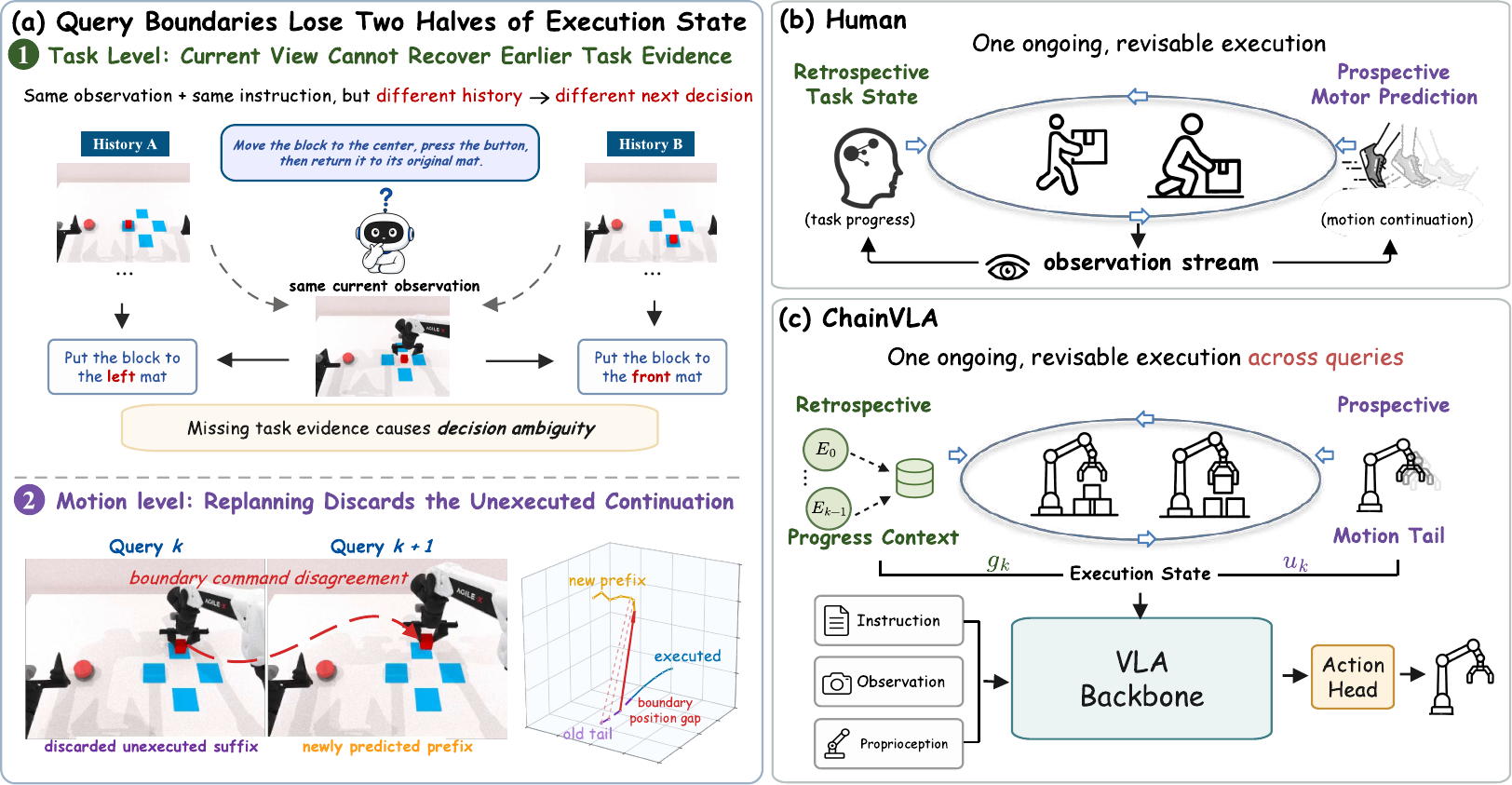
ChainVLA teaser figure

Highlight

1. Unified Execution State: ChainVLA chains successive receding-horizon VLA queries through a joint and revisable execution state, so each new prediction inherits both the task progress and the unfinished motion of the preceding query instead of restarting from the current input alone.

2. Progress Context: A recurrent Working State combined with a Sparse Event Memory carries observation-derived task progress, keeping evidence that has left the current view available to condition each new decision.

3. Motion Tail: The preceding prediction's unexecuted continuation conditions state construction and trajectory initialization, while the decoder regenerates every horizon position under the latest observation, keeping the carried state a revisable prior rather than a fixed plan.

4. Strong Results: ChainVLA reaches 62.8% average success on memory-dependent RMBench and 98.8% across four LIBERO suites. Removing Motion Tail or Progress Context collapses RMBench success to 11.2% and 3.0%, while post-decoding seam smoothing alone recovers at most 2%.
Method

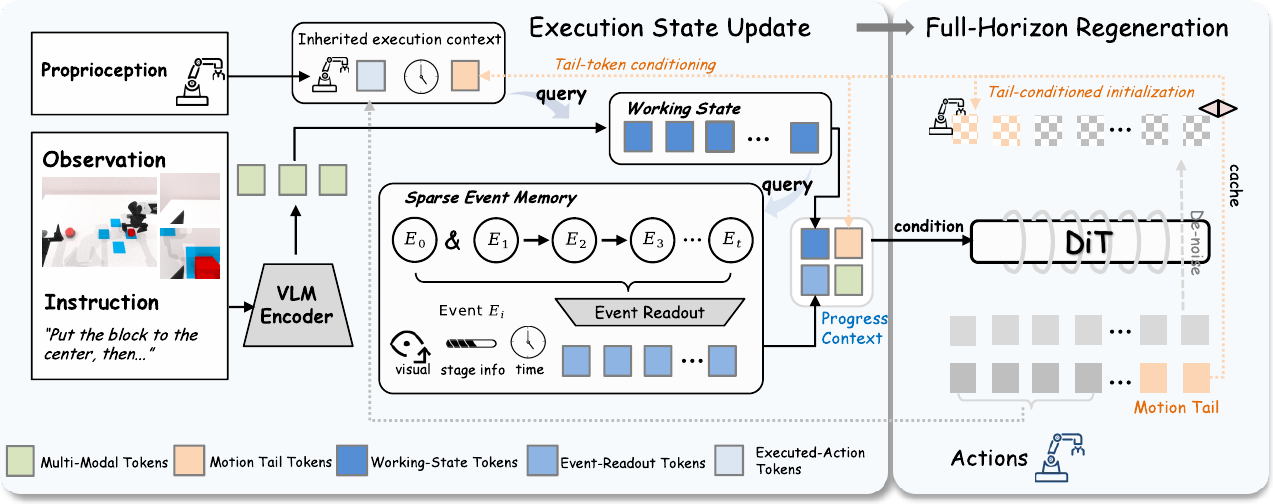
ChainVLA method overview

At each query, Progress Context combines live Working State tokens with event evidence retrieved from the Sparse Event Memory, while Motion Tail carries the preceding prediction's unexecuted suffix into state construction and action generation. The decoder regenerates the full horizon under the latest query input; prefix execution then advances task progress, and the newly predicted suffix is carried forward for the next query.

Tasks

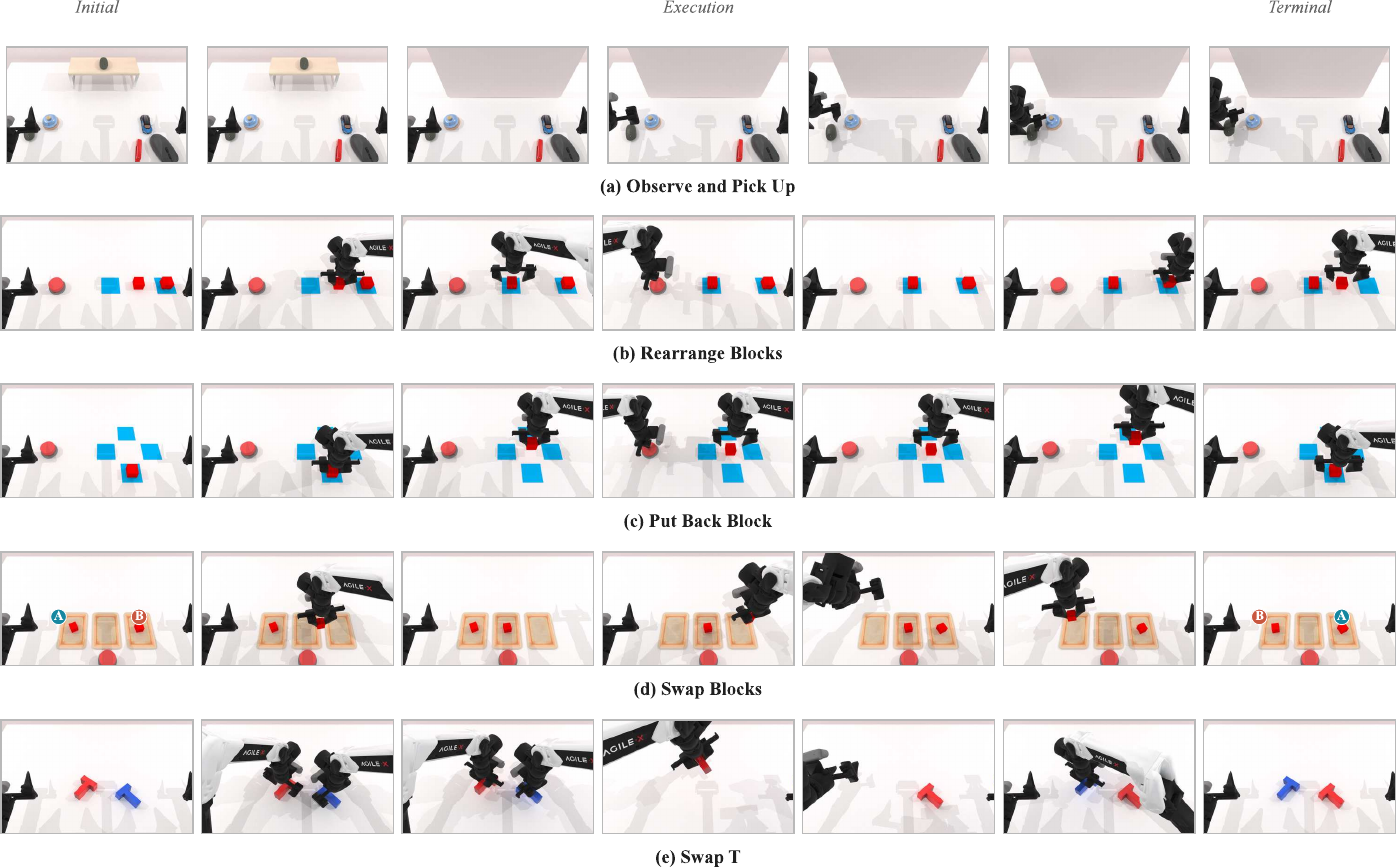
RMBench task overview

RMBench provides five memory-dependent bimanual tasks, each requiring several placements in sequence, so a single episode passes through multiple stages and therefore multiple query boundaries. We additionally evaluate on the Spatial, Object, Goal, and Long suites of LIBERO as a breadth check.

Results

Success rates (%) on RMBench. Best and second-best listed values are bold and underlined.
PolicyObs.Rearr.Put B.Swap B.Swap T.Avg.
DP10011206.4
ACT1290226.8
π0.5 (2.6B+0.3B)91311241514.4
X-VLA (0.9B)9131816311.8
MemER71701479.0
MemoryVLA (7B+0.3B)0225017919.6
Mem-0 (8B+2B)48990671452.8
MemoAct49841--55--
ChainVLA (1.2B)119396744062.8
Success rates (%) on LIBERO.
PolicySpatialObjectGoalLongAvg.
OpenVLA (7B)84.788.479.253.776.5
SpatialVLA (3.5B)88.289.978.655.578.1
π0-FAST (3B)96.496.888.660.285.5
GR00T-N1 (2.2B)94.497.693.090.693.9
π0 (3.3B)96.898.895.885.294.2
π0.5 + KI98.097.895.685.894.3
PAM86.197.094.584.790.6
MemoryVLA (7B+0.3B)98.498.496.493.496.7
CronusVLA (7B)97.399.696.994.097.0
X-VLA (0.9B)98.298.697.897.698.1
ChainVLA (1.2B)98.499.499.298.298.8

Comparison rows follow the cited references and were not rerun under our protocol.

Matched ablations on RMBench (100 episodes per task). Best non-Full values are underlined.
ConfigurationObs.Rearr.Put B.Swap B.Swap T.Avg.
Task-progress side (motion continuation kept)
w/o Stage Ann.108478613453.4
w/o Live Tokens107872482847.2
w/o Event Readout96525382432.2
w/o Progress Ctx.640143.0
Motion-continuation side (task progress kept)
w/o Tail Tokens87878583852.0
w/o Traj. Init.76045453338.0
w/o Motion Tail124022911.2
No carried state, and a substitute
w/o Both400041.6
FIFO Hist. + TE85847402535.6
ChainVLA (Full)119396744062.8

Removing either half of the carried state collapses performance, while the complete state is required for the full gain.

Post-decoding smoothing controls. Success (100 episodes) and position CD (mm, lower is better).
MethodPut Back BlockSwap Blocks
Succ.CDpSucc.CDp
w/o Motion Tail05.90210.06
Linear Cont.02.0923.72
Temporal Ens.03.5707.52
Full962.69743.49

Post-decoding controls reduce most measured boundary errors yet recover at most 2% success: reducing output-level seams alone does not explain the complete-policy gain.

BibTeX

@misc{huang2026chainvla,
  title={ChainVLA: Chaining Vision-Language-Action Queries through a Unified Execution State for Long-Horizon Manipulation},
  author={Yuzhi Huang and Weijue Bu and Ziyi Xiong and Jie Wu and Fanding Huang and Jingyan Jiang and Zhi Wang},
  year={2026},
  eprint={2608.02326},
  archivePrefix={arXiv},
  primaryClass={cs.RO},
  url={https://arxiv.org/abs/2608.02326},
}